Table of Contents
If a doctor has told you that you have a bulging disc or a herniated disc, you’ve probably wondered what the actual difference is and whether one is worse than the other. The two terms get used loosely, sometimes interchangeably, which adds to the confusion. They’re related but genuinely different conditions, and understanding the distinction helps you make sense of your diagnosis and what it means for treatment.
Start With What a Disc Actually Is
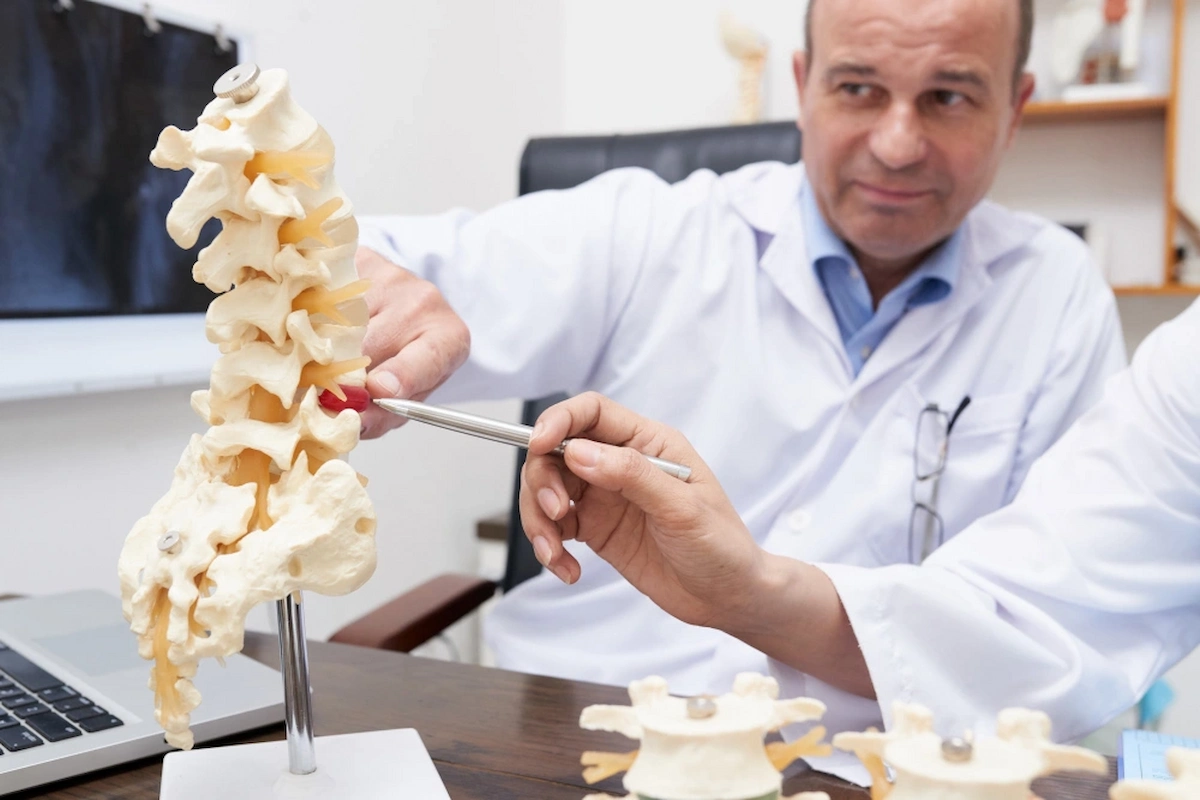
The intervertebral discs sit between the vertebrae of your spine and act as cushions and shock absorbers. Each disc has two main parts. The outer layer, called the annulus fibrosus, is a tough, fibrous ring made of layered cartilage. The inner core, called the nucleus pulposus, is a soft, gel-like center.
Think of it a bit like a jelly donut: a firm outer ring surrounding a soft center. The difference between a bulging disc and a herniated disc comes down to what’s happening to that structure – and whether the inner gel has broken through the outer ring.
What a Bulging Disc Is
A bulging disc occurs when the disc flattens and extends outward beyond its normal boundary, but the tough outer layer stays intact. The inner gel hasn’t broken through – the whole disc has just spread out and pushed beyond where it should sit, a bit like a hamburger patty that’s slightly too big for the bun and pushes out around the edges.
Bulging discs are extremely common and are largely a normal part of aging. Many people have bulging discs on imaging with no symptoms whatsoever. A bulge only becomes a problem if it extends far enough to press on a nearby nerve root or the spinal canal – and even then, because the outer layer is intact, the compression is often milder and more diffuse than what a herniation produces.
What a Herniated Disc Is
A herniated disc is a step further. Here, the tough outer layer has cracked or torn, and the soft inner gel has pushed through the tear – like the jelly escaping from the donut. This is also called a ruptured or slipped disc, though “slipped” is misleading since the disc doesn’t actually slip anywhere.
Because the inner material has broken through, a herniated disc tends to produce more focused, intense symptoms. The escaped gel can press directly on a specific nerve root, and it also releases inflammatory chemicals that irritate the nerve. This combination of direct pressure plus chemical irritation is why herniated discs often cause sharper, more clearly radiating pain than bulges do.
Is a Herniated Disc Worse Than a Bulging Disc?
This is the question everyone asks, and the answer is: usually, but not always.
In general terms, a herniation represents more significant structural damage than a bulge, because the disc wall has actually torn. And herniations more frequently produce the intense, radiating nerve symptoms that send people looking for help. So on average, a herniated disc is the more serious of the two.
But “worse” depends far more on symptoms than on the label. A large bulging disc pressing firmly on a nerve root can produce more pain and dysfunction than a small herniation that isn’t contacting any neural structure. Plenty of people have herniated discs on their imaging and feel completely fine, while others have significant symptoms from a bulge. What matters clinically is not which word is on your report – it’s whether the disc is compressing or irritating a nerve, and how much.
This is one of the most important things to understand about disc diagnoses: the imaging finding and your actual symptoms don’t always match. Treatment should be guided by your clinical picture, not just the terminology.
Symptoms the Two Conditions Share
Both bulging and herniated discs, when they do compress a nerve, tend to produce similar categories of symptoms depending on where in the spine they occur.
In the lower back, a disc problem pressing on a nerve root often produces sciatica – pain that radiates from the lower back through the buttock and down the leg, sometimes with numbness or tingling. In the neck, disc problems can produce pain, numbness, or weakness that travels into the shoulder, arm, and hand. Both conditions can also cause local back or neck pain and stiffness without radiating symptoms.
The pattern of symptoms tends to differ in intensity and focus rather than in kind – herniations often more sharply defined, bulges often more diffuse – but there’s significant overlap, which is another reason the specific label matters less than the clinical evaluation.
How Both Conditions Are Treated
Here’s some genuinely reassuring news: the large majority of both bulging and herniated discs are treated successfully without surgery. The conservative treatment approach is similar for both conditions, adjusted for severity and the specific symptoms involved.
Spinal Decompression Therapy
For both bulges and herniations that are compressing a nerve, non-surgical spinal decompression is one of the most targeted conservative treatments available. It works by creating negative pressure within the affected disc, which helps draw the displaced material back toward center, reduces pressure on the nerve, and improves the flow of nutrients and fluid into the disc to support healing.
Chiropractic Adjustments and Cox Flexion-Distraction
Restoring proper motion to the spinal segments around the affected disc reduces the mechanical stress on the disc and addresses the joint restriction and muscle guarding that develop around a disc problem. Cox Flexion-Distraction is a gentle, hands-on technique particularly well-suited to disc conditions, using controlled flexion to decompress the disc and open space for the compressed nerve.
Time and Appropriate Care
Many disc problems, particularly bulges and smaller herniations, improve considerably with time and appropriate conservative care as the inflammation settles and the disc material gradually retracts. The role of treatment is to support and accelerate that process, reduce the nerve compression driving the symptoms, and address the mechanical factors that contributed to the problem.
When Either Condition Needs More
Surgery becomes a consideration for either condition when there’s severe or progressive nerve compression, significant and worsening weakness, or a failure to respond to a reasonable course of conservative care. These situations are the minority. Any signs of serious neurological involvement – such as significant loss of strength or changes in bowel or bladder function – warrant immediate medical evaluation regardless of whether the underlying issue is a bulge or a herniation.
What This Means for You
Whether your diagnosis is a bulging disc or a herniated disc, the most important factors are what symptoms you’re experiencing and whether a nerve is being compressed – not the label itself. Both conditions respond well to conservative care in most cases, and both are worth getting properly evaluated so the treatment matches your actual clinical situation rather than just the term on your imaging report.
At Castle Rock Chiropractic, Dr. Dickason evaluates disc problems based on your full clinical picture – the symptoms, the physical examination, and the imaging together – to determine what’s actually going on and what approach makes the most sense. If you’ve been diagnosed with a bulging or herniated disc, or you have symptoms that sound like a disc problem, reach out to Castle Rock Chiropractic at 303-688-2300 or schedule a consultation. Dr. Dickason will give you a clear, honest explanation of your specific situation and what conservative care can do for it.

About Dr. Clint Dickason, DC
Dr. Clint Dickason founded Castle Rock Chiropractic to serve his local community with personalized, natural wellness care. An Indiana native and Palmer College of Chiropractic graduate, he brings advanced training in clinical neurology and upper cervical techniques to Colorado families.
With athletic background in wrestling, football, and rugby, Dr. Dickason understands active lifestyle demands. He combines 20+ chiropractic techniques with Blood Flow Restriction therapy certification to address Castle Rock’s unique hiking, work, and family challenges.