Table of Contents
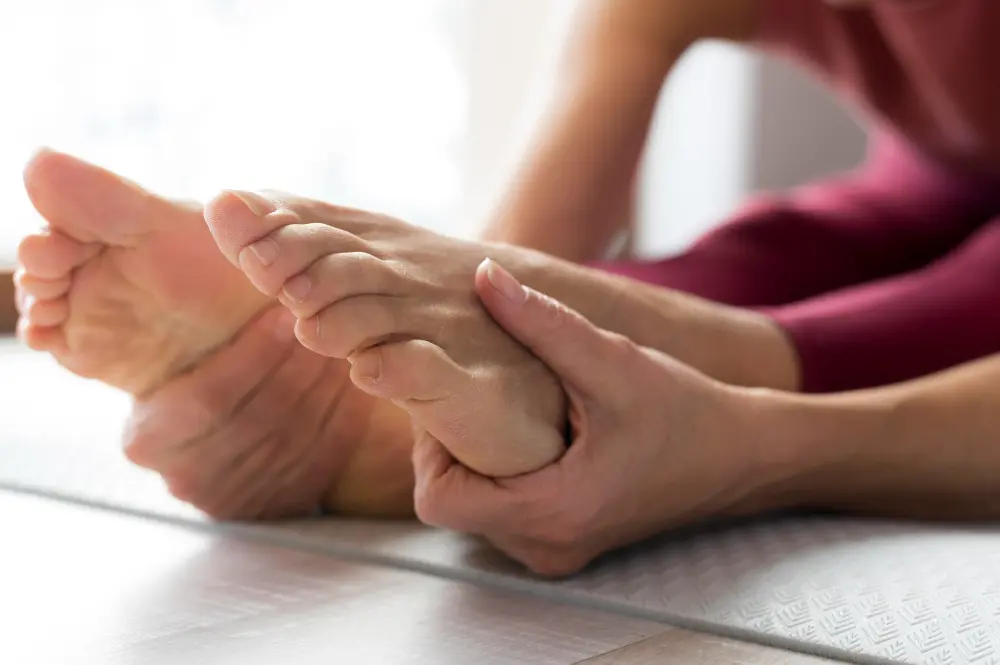
When your back hurts, your feet are probably the last place you’d think to look. But the way your feet function has a direct effect on everything above them – your ankles, knees, hips, and yes, your spine. For some people with stubborn back pain that never seems to have an obvious cause, the real problem starts at the ground. Here’s how your feet can drive back pain and what to do if they’re the missing piece.
Your Body Is a Connected Chain
The key concept here is that your body works as an interconnected chain, often called the kinetic chain. Your feet are the foundation of that chain – the base that everything else is built on and balanced over. When the foundation isn’t functioning properly, the structures above it have to compensate, and those compensations travel all the way up to the spine.
Think about a building with a foundation that’s slightly off. The problem doesn’t stay at the foundation – it shows up as cracks in the walls and misaligned doors on the upper floors. Your body works similarly. A problem at the feet rarely stays at the feet; it gets passed up the chain and often shows up somewhere else entirely, including your lower back.
How Foot Problems Travel Up to the Spine
Several common foot issues can contribute to back pain through this chain reaction.
Flat Feet and Fallen Arches
When the arches of your feet collapse or are naturally flat, the foot tends to roll inward – called overpronation. That inward roll causes the lower leg to rotate inward, which affects the alignment of the knee, then the hip, and ultimately tilts and stresses the pelvis. Since the pelvis is the base of the spine, a pelvis that’s being pulled out of position by foot mechanics can drive lower back pain. Flat feet are one of the more common foot contributors to spinal stress.
High Arches
The opposite problem – arches that are too high – creates its own issues. High-arched feet tend to be rigid and poor at absorbing shock. Instead of the foot dissipating the impact of each step, more of that force travels up the chain to the knees, hips, and spine. Over time, that increased impact loading can contribute to back pain, particularly in active people who are on their feet or running frequently.
Leg Length Differences
A difference in leg length – even a small one – causes the pelvis to tilt to accommodate it, which introduces a curve and asymmetric loading into the spine. Leg length differences can be structural (an actual difference in bone length) or functional (created by foot mechanics, pelvic position, or muscle imbalance). Either way, the resulting pelvic tilt is a recognized contributor to chronic back pain and can be part of the picture in people whose pain is one-sided.
Gait Problems
How you walk matters. An abnormal gait pattern – whether from a foot problem, an old injury you’ve compensated around, or a habit – changes how forces are distributed through the entire chain with every single step. Over thousands of steps a day, even a subtle gait abnormality can accumulate significant asymmetric stress on the spine and pelvis.
Signs Your Feet Might Be Involved
Foot-driven back pain doesn’t announce itself obviously, but certain patterns raise the possibility that your feet are part of the problem:
- Back pain that’s worse after being on your feet or walking for extended periods
- Uneven wear patterns on your shoes – one side or area wearing down faster than the other
- Foot pain, ankle pain, or knee pain alongside your back pain
- Visibly flat feet or very high arches
- Back pain that’s predominantly one-sided
- A history of foot or ankle injuries you compensated around
- Back pain that hasn’t responded to treatment aimed only at the back
That last point is worth emphasizing. When back pain doesn’t respond well to care focused solely on the spine, it’s worth looking further down the chain for a contributing cause that’s been overlooked.
Why This Gets Missed So Often
Foot-driven back pain is commonly overlooked for a simple reason: the pain is in the back, so that’s where attention goes. When the source is somewhere else entirely – the feet, the base of the chain – treating only the painful area addresses the symptom without touching the actual driver.
This is the same principle behind referred pain and misidentified pain sources generally: where it hurts and what’s causing it aren’t always the same place. A thorough evaluation looks at the whole picture, including how you stand, how you’re aligned from the ground up, and how you move – not just the spot that hurts.
How Chiropractic Care Addresses the Whole Chain
The advantage of a whole-body, structural approach is that it accounts for the connections between the feet, pelvis, and spine rather than treating the back in isolation.
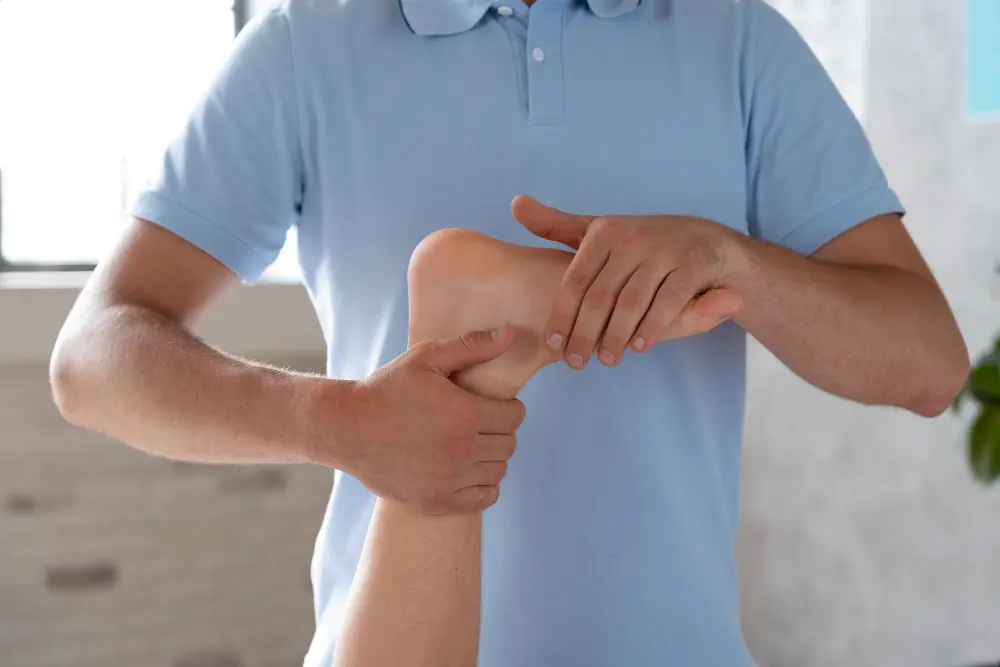
At Castle Rock Chiropractic, Dr. Dickason evaluates posture and alignment from the ground up, assesses how the pelvis is positioned and moving, and considers how lower-extremity mechanics might be contributing to a patient’s back pain. Chiropractic adjustments address the pelvic and spinal restrictions that develop as a result of foot-driven compensation, restoring proper alignment and motion to the structures that have been pulled out of position.
When foot mechanics themselves are a significant factor, addressing the feet directly – through appropriate footwear, orthotic support to correct arch problems, or gait considerations – becomes part of the complete solution. Correcting the spinal compensation while the foundation is still contributing to the problem gives incomplete results; addressing both is what produces lasting relief for foot-driven back pain.
Simple Things Worth Checking
A few practical starting points if you suspect your feet might be involved:
- Look at your shoe wear. Flip your shoes over. Uneven wear patterns are a clue about how you’re loading your feet and whether there’s an asymmetry.
- Assess your footwear. Worn-out shoes, unsupportive shoes, or shoes inappropriate for your foot type contribute to poor foot mechanics. Castle Rock’s active lifestyle means a lot of miles on shoes that may be past their prime.
- Notice the timing of your pain. If back pain reliably worsens with standing and walking, that’s a meaningful pattern pointing toward a possible lower-extremity contribution.
Getting to the Actual Source
If you’ve been dealing with back pain that hasn’t made sense or hasn’t responded to treatment aimed at your back, the answer might genuinely be somewhere you haven’t looked. The feet, as the foundation of the entire chain, are worth considering – especially if you have any of the signs above.
To find out whether your feet are contributing to your back pain, reach out to Castle Rock Chiropractic at 303-688-2300 or schedule a consultation. Dr. Dickason evaluates the whole picture from the ground up and will help you find the actual source of your pain – not just the place where you feel it.

About Dr. Clint Dickason, DC
Dr. Clint Dickason founded Castle Rock Chiropractic to serve his local community with personalized, natural wellness care. An Indiana native and Palmer College of Chiropractic graduate, he brings advanced training in clinical neurology and upper cervical techniques to Colorado families.
With athletic background in wrestling, football, and rugby, Dr. Dickason understands active lifestyle demands. He combines 20+ chiropractic techniques with Blood Flow Restriction therapy certification to address Castle Rock’s unique hiking, work, and family challenges.