
Table of Contents
When your back or neck hurts, figuring out who to see can be genuinely confusing. Chiropractor, physical therapist, massage therapist – they all deal with the body, they sometimes overlap, and it’s not always obvious which one fits your situation. The honest truth is that each does something different, each is the right choice for certain problems, and sometimes the best results come from more than one working together. Here’s how to think it through.
What Each One Actually Does
Understanding the core focus of each profession is the foundation for choosing well. They’re not interchangeable, and they’re not competitors so much as different tools for different jobs.
Chiropractic Care
Chiropractors focus on the relationship between the spine, the joints, and the nervous system. The core of chiropractic care is restoring proper motion and alignment to spinal joints that have become restricted or misaligned, which reduces nerve irritation, relieves pain, and improves how the body functions.
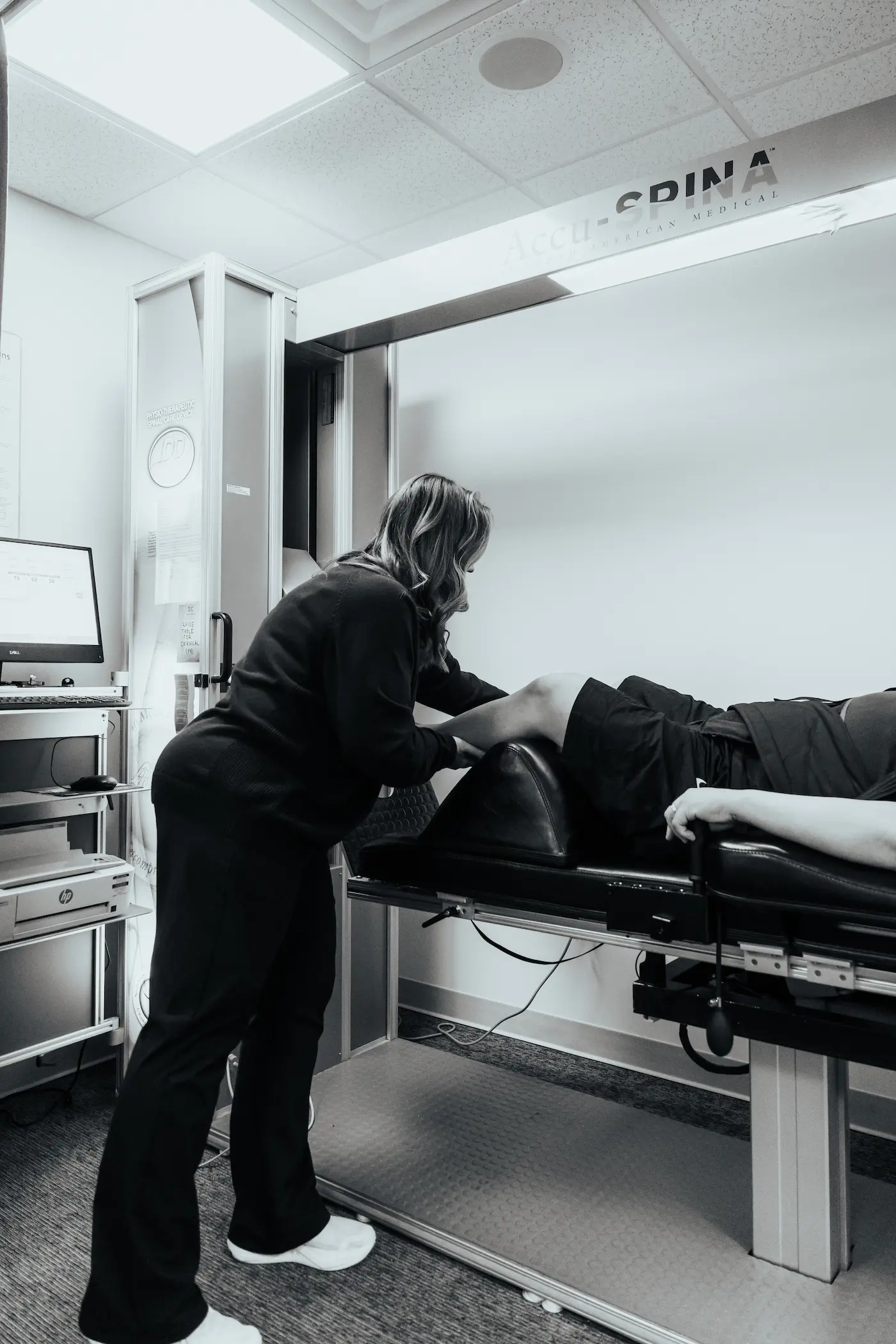
Chiropractic is particularly well-suited to problems involving spinal joint restriction, disc issues, nerve compression, and pain that originates from the structure and mechanics of the spine. When the issue is that something in your spine isn’t moving or sitting the way it should – and that’s driving pain, stiffness, or radiating symptoms – that’s squarely chiropractic territory. A good chiropractor also evaluates the whole picture and will use additional tools like spinal decompression when the condition calls for it.
Physical Therapy
Physical therapists focus on restoring movement, strength, and function, typically through exercise-based rehabilitation. PT is especially valuable for recovering from surgery, rebuilding strength after an injury, addressing significant muscle weakness or imbalance, and retraining movement patterns over a course of progressive exercise.
If your problem centers on weakness, deconditioning, post-surgical recovery, or the need to rebuild functional capacity through structured exercise, physical therapy is often the right fit. PT tends to be very hands-on with guided exercise and active rehabilitation.
Massage Therapy
Massage therapists work primarily with the soft tissues – the muscles, fascia, and related structures. Massage is excellent for releasing muscle tension, improving circulation, reducing stress, and addressing the soft-tissue component of pain and tightness.
If your issue is primarily muscular tension – tight, knotted, overworked muscles without an underlying structural problem – massage can provide real relief. It’s also a valuable complement to other care, helping release the muscle guarding that often accompanies spinal problems.
How to Tell Which One Fits Your Situation
While there’s overlap, certain signs point more clearly toward one approach.
Signs That Point Toward Chiropractic
- Pain that travels from your spine into a limb – down the leg or into the arm
- Numbness, tingling, or radiating symptoms suggesting nerve involvement
- Stiffness and restricted movement in the spine or a specific joint
- Pain that has a clear positional pattern – worse with certain movements or positions
- Recurring back or neck pain that keeps returning despite other approaches
- Disc-related problems, sciatica, or pinched nerve symptoms
Signs That Point Toward Physical Therapy
- You’re recovering from surgery and need structured rehabilitation
- Significant muscle weakness or deconditioning is the main issue
- You need to rebuild strength and function after a major injury
- Your provider has identified specific movement patterns that need retraining over time
Signs That Point Toward Massage
- Your pain is primarily muscular tension without radiating or structural symptoms
- You’re dealing with general tightness, knots, and stress-related muscle tension
- You want to complement other care by addressing the soft-tissue component
Why It’s Often Not Either-Or
Here’s something that gets lost in the “which one should I pick” framing: these approaches frequently work best together. They address different aspects of the same problem, and combining them can produce better results than any one alone.
Consider a common scenario. Someone has a restricted spinal joint that’s driving both nerve irritation and significant muscle guarding around the area. Chiropractic care addresses the joint restriction and nerve component. Massage helps release the muscle guarding. If there’s underlying weakness contributing to the problem, rehabilitation exercise strengthens the structures that need to support the spine. All three pieces address a different part of the whole.
This is why a good chiropractor doesn’t view other providers as competition. Dr. Dickason regularly incorporates soft-tissue work and rehabilitation principles into care, and will coordinate with other providers when a patient’s situation genuinely calls for it. The goal is your recovery, not territory.
Why Starting With a Thorough Evaluation Helps
The challenge with self-selecting a provider is that you’re guessing at what’s wrong based on where it hurts – and as covered earlier, where you feel pain and what’s actually causing it are often different things. You might book a massage for what feels like muscular back tension, when the real issue is a disc problem that massage can’t address. Or you might assume you need extensive rehabilitation when a spinal joint restriction is the actual driver.
A thorough evaluation identifies what’s genuinely going on, which tells you what kind of care your situation actually needs. At Castle Rock Chiropractic, Dr. Dickason’s evaluation process assesses the structural, neurological, and soft-tissue components of your problem. If your situation is best served by chiropractic care, he’ll explain why. If it would benefit from adding other approaches, he’ll tell you that too. And in the cases where another provider is genuinely a better fit for your specific issue, he’ll point you in that direction honestly.
The Castle Rock Bottom Line
There’s no universal answer to “chiropractor, physical therapist, or massage” because the right choice depends on what’s actually wrong. Chiropractic is the right starting point for problems involving the spine’s structure, joints, and nerves – which covers a large share of common back and neck complaints. Physical therapy excels at rebuilding strength and function. Massage addresses soft-tissue tension. And the best outcomes often come from combining them thoughtfully.
If you’re not sure which kind of care your situation calls for, a thorough evaluation will tell you. Reach out to Castle Rock Chiropractic at 303-688-2300 or schedule a consultation. Dr. Dickason will assess what’s actually going on and give you an honest recommendation – even if that recommendation includes more than just chiropractic care.
About Dr. Clint Dickason, DC
Dr. Clint Dickason founded Castle Rock Chiropractic to serve his local community with personalized, natural wellness care. An Indiana native and Palmer College of Chiropractic graduate, he brings advanced training in clinical neurology and upper cervical techniques to Colorado families.
With athletic background in wrestling, football, and rugby, Dr. Dickason understands active lifestyle demands. He combines 20+ chiropractic techniques with Blood Flow Restriction therapy certification to address Castle Rock’s unique hiking, work, and family challenges.