Table of Contents
Degenerative disc disease is one of those diagnoses that sounds far worse than it often is – and one that leaves many patients feeling like their spine is simply wearing out and there’s nothing to be done about it. Neither of those things is accurate. At Castle Rock Chiropractic, Dr. Dickason works regularly with patients who’ve received this diagnosis and helps them understand what it actually means, what it doesn’t mean, and what conservative care can realistically do for their situation.
What Degenerative Disc Disease Actually Is
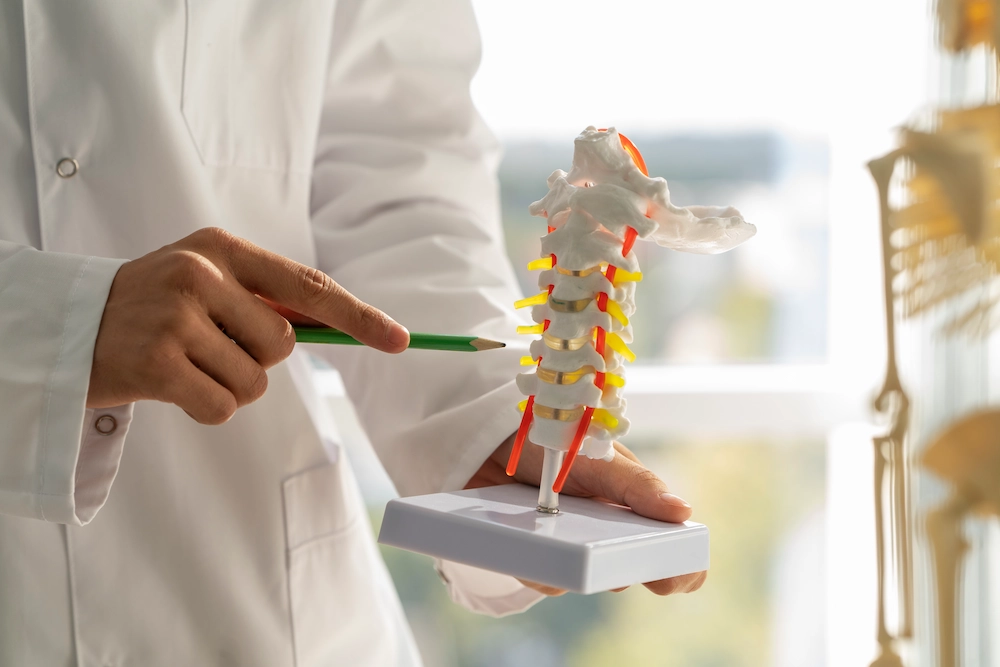
Despite the name, degenerative disc disease isn’t really a disease in the traditional sense. It’s a description of age-related and load-related changes to the intervertebral discs – the cartilage structures between the vertebrae that act as shock absorbers and allow spinal movement.
Discs are largely made of water when you’re young – the nucleus pulposus at the center of each disc is around 80 percent water in early adulthood. That hydration is what gives discs their height, their flexibility, and their ability to distribute load evenly across the vertebral endplates. Over time, through a combination of normal aging, repetitive loading, previous injuries, and sometimes genetics, discs lose water content. They become thinner, less flexible, and less effective at cushioning the vertebrae above and below them.
That process is called degeneration, and to some degree it happens in virtually everyone. Studies consistently show that a significant percentage of adults over 40 have radiographic evidence of disc degeneration with no symptoms at all. The presence of degeneration on an MRI is not, by itself, a reliable predictor of pain.
Why It Sometimes Causes Significant Pain and Sometimes Doesn’t
This is the part that confuses most patients after a degenerative disc disease diagnosis. Why does one person with disc degeneration on imaging have debilitating pain while another with similar findings feels fine?
The answer usually comes down to what the degeneration is doing to the surrounding structures. A disc that has lost height may allow the vertebrae above and below it to move closer together, narrowing the foraminal openings where nerve roots exit the spine. That narrowing can compress a nerve root and produce significant back pain, leg pain, or numbness and tingling. The same degree of disc degeneration without foraminal involvement may produce no symptoms at all.
Degeneration also affects the stability of the spinal segment. When a disc loses its normal height and tensile strength, the facet joints behind it take on more load than they were designed to handle. That increased facet loading can produce local joint pain and inflammation, particularly with extension movements and prolonged standing.
And then there’s the muscle guarding response. The body responds to a vulnerable spinal segment by tightening the surrounding muscles to protect it. That protective tightening is useful in the short term but becomes a chronic pain driver of its own when it persists for months or years.
What Degenerative Disc Disease Does NOT Mean
Before discussing what can be done, it’s worth being clear about what this diagnosis doesn’t mean:
It doesn’t mean surgery is inevitable. The large majority of patients with degenerative disc disease manage their condition well with conservative care. Surgery is typically reserved for cases where nerve compression is severe, progressive, and not responding to non-surgical approaches – not as a first-line response to a diagnosis of degeneration on imaging.
It doesn’t mean your spine is fragile. Degenerated discs are less hydrated and less flexible than younger discs, but they’re not glass. Movement, exercise, and appropriate spinal loading are beneficial – not harmful – for most patients with disc degeneration. Protecting a degenerating disc with inactivity typically makes things worse over time, not better.
It doesn’t mean nothing can be done. Conservative care – particularly spinal decompression therapy and chiropractic adjustments – can meaningfully reduce pain, improve function, and slow the progression of degeneration in many cases.
How Chiropractic Care Addresses Degenerative Disc Disease
The goal of conservative care for degenerative disc disease isn’t to reverse the degeneration itself – mature disc tissue doesn’t regenerate in the way that other structures do. The goal is to manage the consequences of degeneration: the nerve compression, the facet joint overloading, the muscle guarding, and the functional limitations that reduce quality of life.
Spinal Decompression Therapy
Non-surgical spinal decompression is one of the most valuable tools available for degenerative disc disease at Castle Rock Chiropractic. The AccuSPINA system creates controlled negative pressure within the targeted disc, which serves two purposes. First, it reduces the compressive load on an already-thinned disc, providing relief from the nerve root irritation and facet overloading that degeneration produces. Second, it promotes fluid exchange within the disc – the process by which discs receive nutrients and hydration that they can’t get from direct blood supply. While full regeneration isn’t realistic, improved disc nutrition and hydration can slow the degenerative process and support better disc function.
Chiropractic Adjustments
As discs degenerate and lose their normal height and flexibility, the facet joints and surrounding segments often develop secondary restriction. Chiropractic adjustments restore normal motion to those restricted segments, reduce the inflammatory load on overworked facet joints, and address the muscle guarding patterns that develop around a vulnerable disc. Keeping the segments adjacent to a degenerating disc moving properly also reduces the compensatory stress those levels take on when the affected segment is stiff.
Cox Flexion-Distraction
For patients with degenerative disc disease who also have spinal stenosis or significant foraminal narrowing, Cox Flexion-Distraction is often the most appropriate hands-on approach. The gentle, controlled flexion motion opens the posterior disc space and foraminal openings, reducing nerve root compression without the rotational forces of standard manipulation. It’s particularly well-suited to older patients or those with more advanced degeneration where higher-velocity techniques aren’t appropriate.
The Castle Rock Patient With Degenerative Disc Disease
A pattern Dr. Dickason sees frequently in Castle Rock is the active adult in their 50s or 60s who received a degenerative disc disease diagnosis after an MRI and was told to “take it easy” or “learn to manage it.” Many of these patients have spent years modifying their activity – hiking less, skiing less, doing less – based on a diagnosis that doesn’t actually require that level of restriction.
The goal at Castle Rock Chiropractic for these patients is to restore as much function as possible, keep the spine moving well, and give them back as much of their active Castle Rock lifestyle as their spine can support. That often means more than they’ve been led to believe is possible.
What Patients With This Diagnosis Ask Most Often
Will it keep getting worse?
Disc degeneration is a progressive process in the sense that discs don’t spontaneously regenerate. But the rate of progression varies enormously between individuals, and it’s influenced by factors that can be managed – spinal loading patterns, body weight, movement habits, and how well the adjacent segments are maintained. Patients who keep their spine moving well and manage their loading patterns consistently tend to age far better than those who become sedentary after a diagnosis.
Can I still exercise?
In most cases, yes – and you should. Low-impact exercise that maintains core stability, hip mobility, and spinal movement is beneficial for degenerative disc disease. The specific activities that are appropriate depend on which levels are affected and how advanced the degeneration is. Dr. Dickason will give you specific guidance based on your evaluation rather than a blanket restriction.
Do I need to see a spine surgeon?
For most patients with degenerative disc disease and no significant neurological compromise, conservative care is the appropriate starting point and often the endpoint. Dr. Dickason will tell you honestly if your presentation suggests surgical evaluation is warranted – and equally honestly if it doesn’t.
If you’ve received a degenerative disc disease diagnosis and want a clear picture of what your options actually are, contact Castle Rock Chiropractic at 303-688-2300 or visit our new patients page to schedule a consultation. The evaluation will tell you where things actually stand and what conservative care can realistically do for your situation.
About Dr. Clint Dickason, DC
Dr. Clint Dickason founded Castle Rock Chiropractic to serve his local community with personalized, natural wellness care. An Indiana native and Palmer College of Chiropractic graduate, he brings advanced training in clinical neurology and upper cervical techniques to Colorado families.
With athletic background in wrestling, football, and rugby, Dr. Dickason understands active lifestyle demands. He combines 20+ chiropractic techniques with Blood Flow Restriction therapy certification to address Castle Rock’s unique hiking, work, and family challenges.